

by Arunabha Sengupta
(This was first written for and published by Cricket Statistician, the Journal of the Association of Cricket Statisticians and Historians, Spring 2023)
Glorious Uncertaities mean nothing but occurence of LowProbability Events
“Cricket is a game of glorious uncertainties.”
An oft repeated cliché that has been voiced – on the air and otherwise, quoted, recited, written, tweeted and published so many times that it is now considered gospel.
Cricket is brimful with such concepts. “Gentleman’s Game”, “Spirit of cricket”, “The game produces far better literature than any other sport” – all these and other such concepts and claims are vulnerable in the face of rigorous examination. Some can be shown to be wrong from the historical point of view, some constructs are too intangible and vague for meaningful debates, some smack of blissful ignorance of all other sports.
This is not quite the forum to discuss all these topics. Hardcore adherents of any sport can perhaps be pulled up for anointing their chosen sport with spurious attributes of superiority. Cricket is perhaps trendsetting in the way it celebrates ‘Higher Truth’ (and its High Priest), but that is a different discussion altogether.
For the purpose of statistics (mainly because this article was originally written for the Association of Cricket Statisticians and Historians), it is perhaps more relevant to look closely at the claim ‘Cricket is a game of glorious uncertainties.’
Why should we look closely at this claim? Because when we look at statistics as an academic subject, ‘uncertainty’ becomes a technical term. And what is more, it can be measured – or, at least, estimated. The entire body of knowledge of Probability Theory deals with ways of measuring uncertainty.
The first question that arises then is what is ‘glorious uncertainty’. And why is it the domain of cricket more than any other sport?
In 1974, Rowland Ryder wrote an article titled ‘Nothing is certain in cricket – except its uncertainty’. Published in Wisden – no less – it kicked off with these lyrical lines:
“Among the myriad delights of cricket, not least is the glorious uncertainty of the game. Nothing is certain in cricket except its uncertainty. It is not likely that a batsman will hit every ball of an over for six; that a last wicket stand will add three hundred runs to the score; that a wicket-keeper will take off his pads and do the hat trick: none of these things are anything more than remotely possible, yet all of them have happened; and improbable events, their duration in time varying from a split second to a long drawn out week, interesting, exhilarating, something unbearably exciting, are happening every year that cricket is played.”
Very true. Uncertainty in this case is correctly defined as improbable events – in other words ‘events with low probability of occurrence’. And improbable events do occur in cricket. Apart from the ones listed above by Ryder, a cricket fan may well add numerous other examples such as “Bracewell and Boock adding 124 after the ninth wicket went down at 169” or “Michael Clarke capturing 6/7 at Mumbai and he is not even a bowler” or “Alletson’s innings”. A last ball six to win a game, a hat-trick to clinch a close match, a tailender doing the star turn with the bat, collapses against the run of play … all these are examples of exhilarating events with low probability.
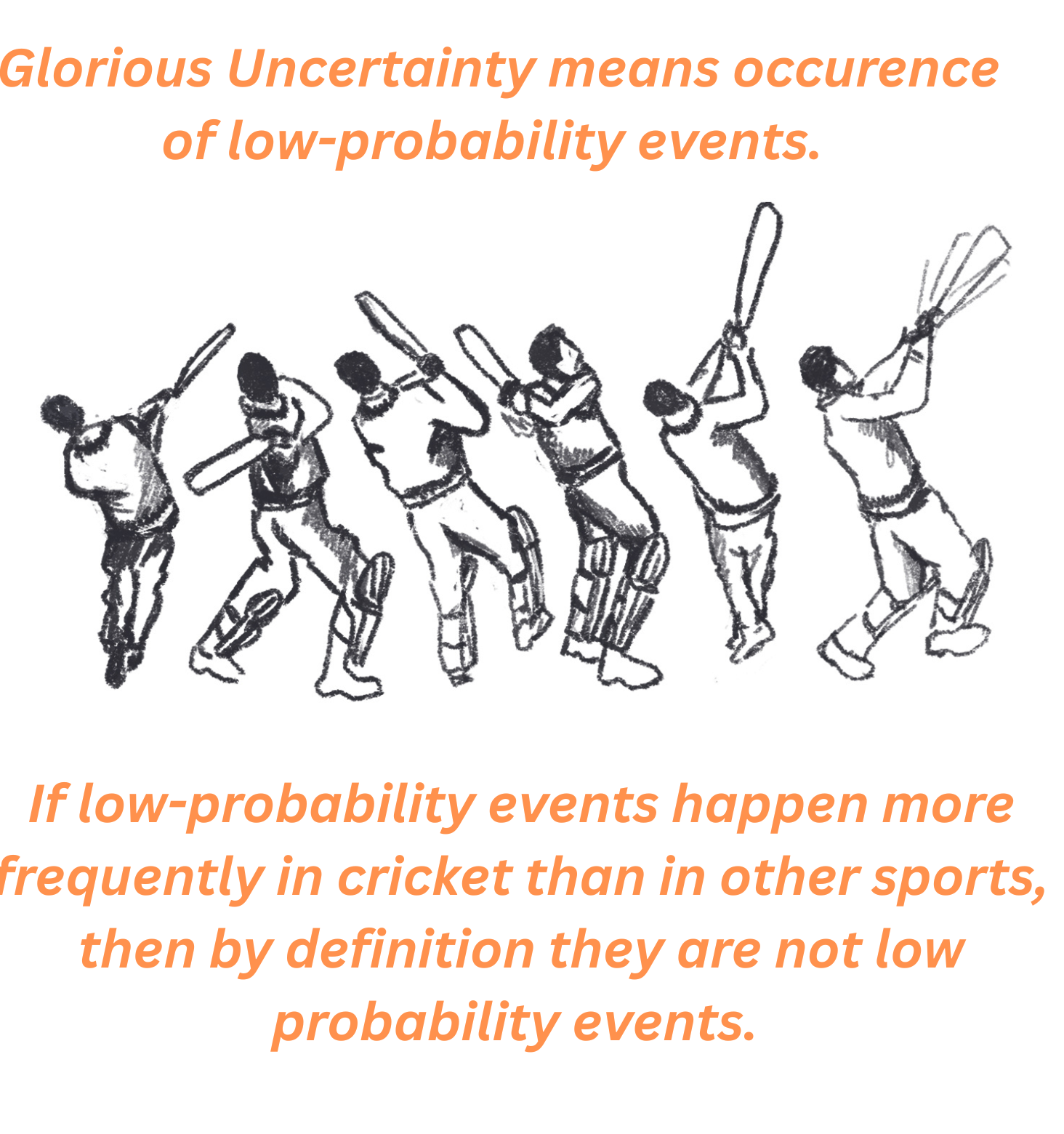
If low-probability events occur more frequently in cricket than in other sports, they cease to be low-probability events
But are they any different from improbable events in other sports?
Intuitively, a tailender scoring a hundred is somewhat akin to a deep defender snatching the ball deep inside his half, launching into an overlapping run and ending up scoring a goal.
A number eleven batsman scoring a hundred is rare. It has taken place only a dozen times in first-class cricket starting with Victorian wicketkeeper Thomas Hastings in 1903. The closest anyone got in Test cricket was when Ashton Agar fell two runs short at Trent Bridge in 2013. It is intuitively similar to – although numerically less frequent than – goalkeepers venturing out and netting one for the team at soccer. The latter has happened six times in the English Premier League alone.
An improbable turnaround through a late order resilience of the Langer-Gilchrist-Hobart variety can be equated to Portugal coming back from 0-3 down to win 5-3 against North Korea in the 1966 World Cup.
Other sports are rife with examples of improbable events as well.
A very rare feat such as six sixes in an over, for instance, can be equated that with a quadruple-double in basketball. This essentially means a player finishes with 10 or more in four of the five major statistical categories – points, rebounds, assists, steals and blocks. This has been done only four times in the entire history of NBA – that is how rare it is.
Another example is unassisted triple play in baseball, which happens when a defensive player makes all three outs by himself in one continuous play, without his teammates making any assists. This is rare enough to have occurred only 15 times in Major League Baseball – the earliest in 1909 and the latest in 2009.
Jim Laker’s 19/90 is unique in Test cricket and is likely to stay that way unless a Test match full of the most glorious uncertainty takes place. It is not unnatural for a cricket fan to be misty-eyed about the event even 66 years after that Manchester Test. But again, if we look at the rather long history of NHL there is only one instance of 10 or more points in a single game – achieved in 1976 by Darryl Sitter.
If we find ourselves out of our comfort zone discussing American sports, we can turn to the more familiar undulating grounds of the golf course. The odds offered for a hole in one vary from 12,500 to 1 for average golfers to 2,500 to 1 for tour professionals. This underlines how rare these events are. Yet they occur. Highly improbable events occur in golf too, like in almost every other sport.
All of us remember the famous 70-68 final set between Isner and Mahut at Wimbledon. It was followed, eight years later, by the oddity of Isner featuring in yet another 26-24 final set against Kevin Anderson in the semi-final of the 2018 tournament – the match that went on to prompt a rule change. Not only are the individual probabilities of such long matches extremely low, Isner being involved in two such matches was almost freakish.
So, events touched by uncertainty (improbable events) can be seen in almost every sport. And they are rightly celebrated in all these sports.
Wickets and Goals
One of the curious arguments for cricket’s claim in this regard – at least one that I have come across more often than expected– proceeds as follows: ‘improbable events are more frequent in cricket than in other sports.’ This rather self-contradictory argument has often been expanded into the following form: ‘In cricket one can see, for example, a non-regular bowler being employed. That is the tactical nature of the game which brings in unusual manoeuvres and thereby makes it the King of Games. Other sports lack this aspect. Hence a wicket for a non-regular bowler is more frequent than a similar improbable event in another sport.’
The statement and the explanation are of course fallacious. Improbable evets, if they occur more frequently, become more probable and lose their degree of uncertainty. That is how certainty or uncertainty – in other words probability of an event – is estimated.
If a non-regular bowler takes wickets more frequently than, say, a goalkeeper scoring a goal, it does not mean that cricket is more prone to uncertain events. It just means a goalkeeper scoring a goal is less probable than that non-regular bowler taking a wicket.
But at the same time there will be some event in the football world with an approximately equivalent probability, which occurs approximately as frequently as a non-regular bowler taking a wicket.
Let us demonstrate the equivalence with an example.
Joe Root capturing four or more wickets in a Test match innings is a rather improbable event. It has, however, happened more than once – for some fans that does underline the game’s glorious uncertainties.
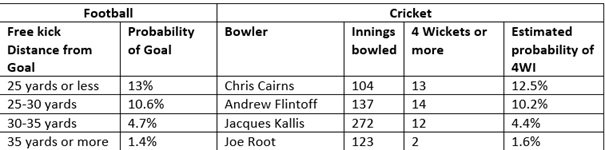
Root has been given a bowl in 123 innings (well, on 62 of those occasions he tossed the ball to himself) and he has achieved the feat twice. This gives us an estimated probability of 2/123 = 1.62% of Root capturing four or more wickets if he is given a bowl. It is a rare-enough feat to fascinate us. (Of course, there are other factors that influence – some positively some negatively – whether or not someone takes four wickets, but we will keep things simple for this example.)
Now let us turn to football. Eliot McKinley of the Vanderbilt University studied free kicks in Major League Soccer and analysed how many of them resulted in a goal. He estimated that from within 25 yards, 13% of the free kicks result in goals, if taken from between 25 to 30 yards the frequency drops to 10.6%, between 30 and 35 yards it drops further to 4.7% and from beyond 35 yards the probability is a low 1.4%.
Hence, if we place the two sports next to each other, Joe Root taking four or more wickets in a Test match innings is just slightly more probable than a free kick resulting in a goal from a distance of 35 yards or more.
Now picture Ronaldiho floating that freekick over David Seaman from 42 yards in 2002. Would a football fan from Brazil agree that either Root’s 5/8 at Ahmedabad or his 4/87 at St George’s Park was even close to being as glorious as the improbable goal at the Shizuoka Stadium that took the Latin Americans into the semi-final?
The gloriousness of the uncertainty lies in the eyes of the aficionado.
Coming back to our comparative study, for Jacques Kallis the probability of 4 or more wickets in an innings is 4.4% (12 times in 272 innings) Hence, for him the probabilistic equivalent is approximately a free-kick from 32-35 yards.
As the bowler becomes more mainstream I would expect the equivalent freekick to be taken closer and closer to the goal. The table more or less demonstrates the same.
Mapping probability of events across sports
(The figures of Joe Root are as of December 2022)
The inference is that by varying the distance from the goal we can match the (im)probability of any cricketing event (perhaps other than aspects of Don Bradman’s career which even the relative certainty of penalty kicks will probably fail to estimate).
This is just an illustration.
There are of course other low probability events that can be found in football. And similar exercises can be carried out with most sports.
Conclusion
Rowland Ryder was of course lyrical in his use of the term ‘uncertainty’. But the romantic assertion will wither under the scrutiny of the most basic probabilistic rules. Every sport has improbable events. And they occur in the frequency proportional to their low probability. Whatever he said about cricket’s ‘uncertainty being its only certainty’ is true for every other sport.
It is of course understandable that a cricket fan will find the uncertainties (low probability events) of cricket more fascinating than similar occurrences in other sports. But the same goes for other sports as well. The argument ‘my uncertainty is more glorious than yours’ is silly.
When Rishabh Pant scoops the spearhead of the opposition over the slips during a crunch moment of a Test match and the ball races to the fine boundary, the rarity of such a stroke coming off successfully will hold the cricket fan in raptures of awe. A golf enthusiast will find similar wonder in the 16th hole at the 2005 Masters, with Tiger Woods chipping from the border of the rough, the hush descending as the ball unbelievably veers towards the hole, the agony as it stops on the brink for a whole two seconds, and the ecstasy as it finally drops in.
While Gilbert Jessop turning the Oval Test on its head with his rollicking century – his only one in Test cricket – after coming in at 48-5 will remain one of the most glorious improbable events of cricket, Adolf Anderssen sacrificing two rooks and his Queen to beat Lionel Kieseritzky in London, 1851, will be played and replayed thousands of times by chess enthusiasts because it is the rarest of rare gems to have graced the 64-square world of that noble game.
All these are rare occurrences. All these glorious in themselves.
Cricket fans can justifiably delight and exult when an improbable event takes place. But we need to understand that cricket has no monopoly on improbability.
The cliché ‘cricket is a game of glorious uncertainties’ is meaningless.