
by Mayukh Ghosh
Seven of Max Bonnell’s books have been published in the previous 24 months.
The likes of David Lemmon and Jack Pollard had that sort of strike rate but Bonnell, thankfully, is not a reckless slogger!
The quality which has always been right up there, has been maintained.
I wondered how!
Bonnell explained, “Some of them took much longer to develop. Sometimes things sit around as a bundle of half-done research for a while and then come together. At the moment I have two ideas I'm playing around with. But they may not come to anything. I won't try to publish anything unless I find something to say that's new and interesting, and I'm about halfway there at the moment. And then I'm more or less out of ideas. It's getting harder to find subjects that haven't already been handled well by someone else….”
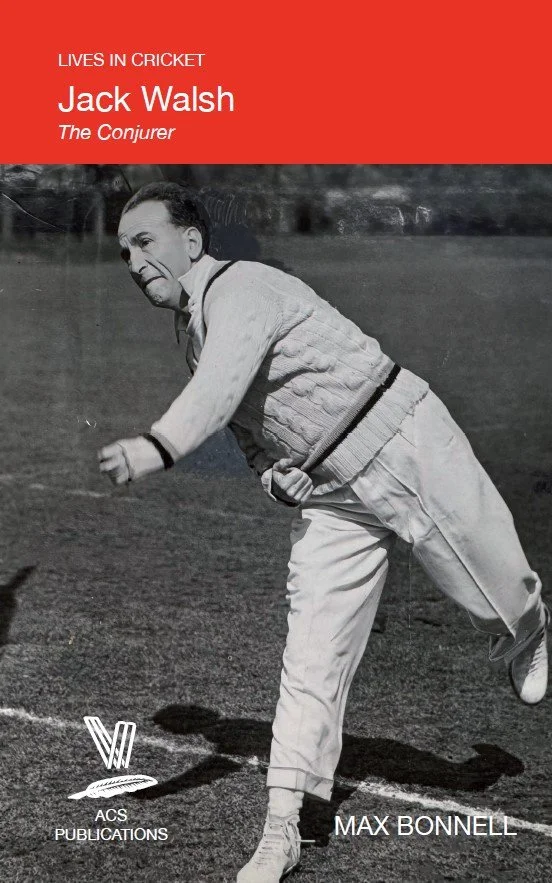
The latest is a biography of Jack Walsh, the Australian who became a county stalwart in the immediate post-war years. Not the conventional subject but that’s hardly surprising. Bonnell had earlier written on Herbie Collins, Jack Ferris, Tibby Cotter, Bert Ironmonger, Leslie Poidevin,….
It’s the story that always matters more than the enormity of the names. Walsh, as Bonnell found, had one.
It, despite being a recent project, had its roots way back to a time when the author was in his teens.
“The trigger goes back to when I was 16. I started training with my local Grade club, Western Suburbs in Sydney. In the net next to me there was a leg spinner bowling in a very exotic cricket jumper - green and red stripes with a fox in the centre. I'd never had a cricket jumper of any description, so someone training in a Leicestershire County sweater really stood out. It was Peter Walsh, Jack's nephew, who bowled leg spin in First Grade. I ended up playing a handful of games with him many years later. So, I was always vaguely aware of who Jack Walsh was.
“A few years back I got thinking about the large number of Australian players who moved to England after the war. There were so many of them: Tribe, Dooland, McCool, Walsh, McMahon, Grieves, Alley, Pepper, Livingston, Walker, Jackson and others. I thought there would be some good stories in there, started with Walsh and stayed with him.
“Part of the appeal was the sheer strangeness of his career. He was not much more than a battling club cricketer when Alan Fairfax recruited him to play for Sir Julien Chan, an eccentric English millionaire who owned a large furniture business. Cahn employed several cricketers who supposedly worked in his business but really were full time cricketers. They spent most of their time obliterating strong amateur club teams, but they also toured, which is why Walsh actually made his first-class debut in Ceylon. Then the war intervened, so he was 33 before he signed his first professional contract - yet he was still good enough to take 1190 wickets. If he'd had time to qualify by residence, he'd probably have played for England sometime between 1947 and 1949 but then Lock and Laker emerged and his moment had passed.”
Most of Bonnell’s previous books have been on people who led strange and/or intriguing lives, besides whatever they did on the cricket field.
Walsh is an aberration in that respect but there was enough in his cricket that ticked the box for Bonnell.
“I'm often drawn to characters with broad lives, people who did interesting things outside the game. There's less of that with Jack Walsh. He was unemployed during the depression when he agreed to play cricket for Julien Cahn and apart from the war years, cricket was his main occupation after that. He was a professional at Leicestershire for more than a decade, and after that he had lots of coaching positions. I suppose what really makes him interesting is that he chose to bowl left-arm wrist spin. He started out as a perfectly good orthodox spinner, but he thought that was a boring thing to do, so he chose the more entertaining, but riskier, path.”
Given Walsh’s cricket was the centre of attention, no wonder Bonnell found out unknown and fairly surprising facts about the man’s cricket. And, along the way, a bit on his life too!
“I hadn't appreciated how hard his early life was. He was raised, essentially, in the depression. He managed to find work, but when he turned 21 he was sacked because his employer would have needed to pay higher, adult wages. So, a lot of his life was pretty tough. I hadn't known about that side of his life. I think he came out of it a surprisingly well-adjusted character, given the amount of financial hardship he faced over the course of his life. Even as the highest-paid Leicestershire cricketer, money was often very tight. The other great thing that comes through is his sheer love of bowling. He could have done very well as an orthodox left-arm spinner, but nothing gave him more fun than spinning the ball as hard as he could. He sometimes gave the impression that he'd rather spin a ball a foot than take a wicket.”
Bonnell’s work is always thoroughly researched and properly thought out and this one is no exception. Despite that, as is always the case, there were lost opportunities.
“There's a rule that, as soon as you send something off to the printer, you learn something you wish you had included. In this case, I was contacted by someone who had come into contact with Walsh when he was coaching in Tasmania. It would have been good to use that material, and I would have liked to have found out more about his time coaching in what was then Rhodesia (Zimbabwe), but I couldn't locate much about that.”
Having said that, Bonnell managed to unearth a lot of information and Walsh’s nephew Peter and daughter Claire had shared some helpful insights.
And the satisfying bit is that the family members said that they have liked it.
This is not the first time a Bonnell book has been published by ACS and he has his reasons for having them as the publisher.
“ACS has an excellent publishing program and it cares about the kinds of books I tend to write, for which the commercial market isn’t huge. It’s very hard getting interest from commercial publishers unless your book is likely to have wide appeal. ACS likes to tell the stories that have a more niche market and it’s good at distributing the books to the readers who like them, so it was a good fit for Walsh.”
Jack Walsh: The Conjurer is available for the ACS, as well as from the usual outlets in Australia and the United Kingdom.