
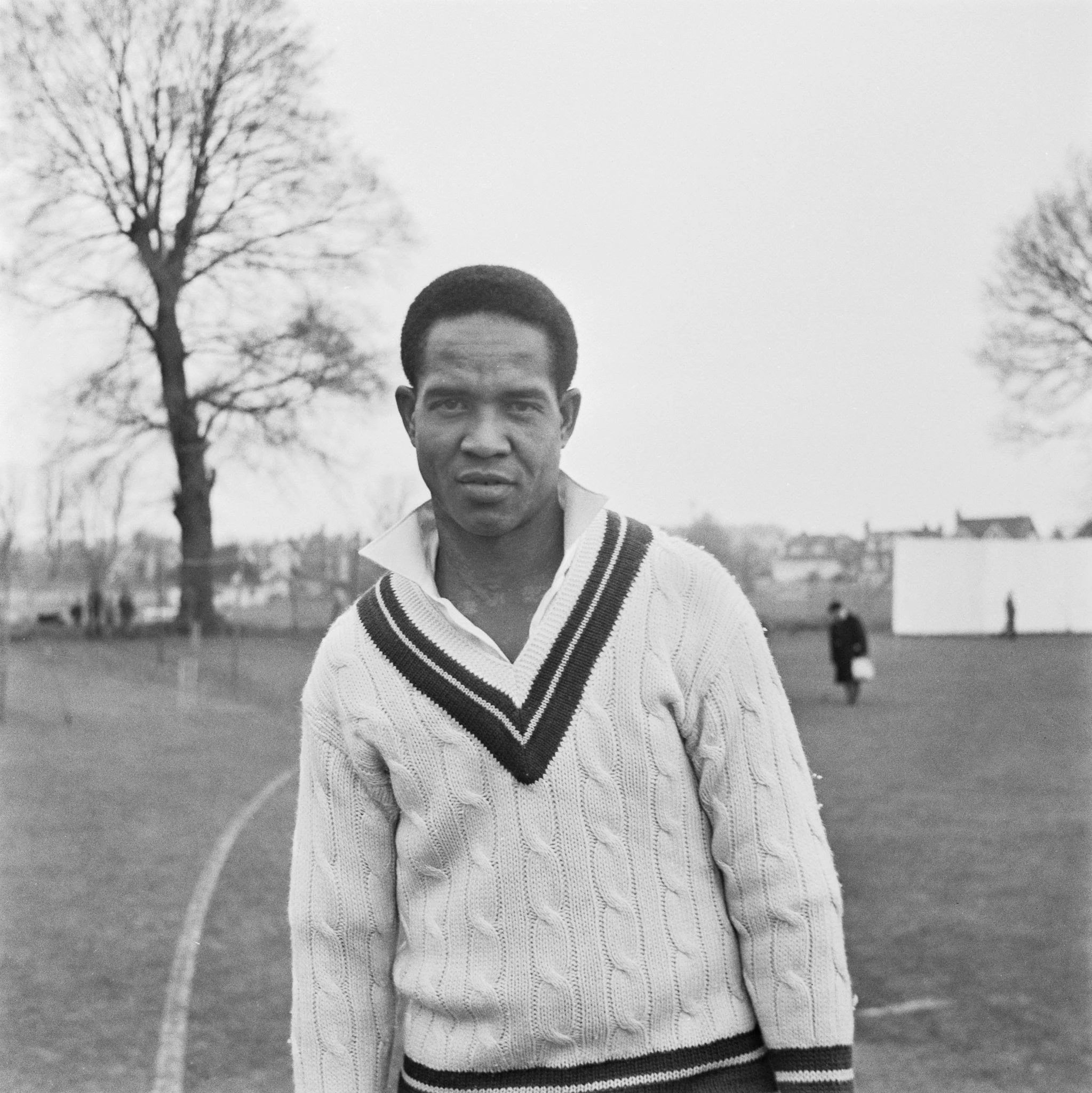
There have been attempts to decipher the Garry Sobers code.
What was it that constructed this incredible force who swept through the cricketing world for almost twenty years?
Some have suggested it was the oddity of his being born with six fingers in each hand.
Others have delved deep into the life and the man’s own words, and have sought answers in the old cricket balls the young Sobers played with. They were scrounged from the rejects of the local Wanderers ground where Dennis Atkinson and others would have a hit. The balls, with ruptured seams, would be crudely stitched together by the local shoemaker, and would result in bizarre movements in the air.
Still others have put it down to the accident on the A34 near Stone in Staffordshire in 1957, with Sobers behind the wheel and the superbly talented Collie Smith sleeping in the back. The legend often confessed that the death of Collie Smith had mortified him, and had led him to realise that from then he would have to play for himself and Smith.
The definite reason may remain unknown, but the end result was a freak of nature, the like of whom the world has never been seen before or since.
As a batsman he was undoubtedly the best in the world in his time, certainly the most sublime attacking stroke-player, and to this day stands as one of the most supreme wielders of the willow across the entire history of the game.
As a bowler, there have been many better, but few as versatile. He could take the new ball, run in quick and make it dart about. When the ball was older, he could spin it in time honoured orthodox manner. Or he could resort to turning it from the back of his hand, sharply and in both ways.
And as a fielder, he could pouch half-chances in the slip, and at leg-slip grab even those which did not register as chances at all. If, for the sake of variety he was placed in the covers, he could chase like a greyhound and pick up and throw in one action, searing, flat and accurate. He was undoubtedly the greatest all-round fielder of the era.
When he ended his career, he was the highest run-getter in Test cricket, with the highest individual score in an innings, the second highest wicket taker for West Indies and was third in world on the table of catches held by non-wicketkeepers.
Ray Robinson called him “evolution’s ultimate specimen of cricketers.”
CLR James, with his penchant for infusing the game with sentiments of emancipation, went further, marking him “the living embodiment of centuries of tortured history, a West Indian cricketer, not merely a cricketer from the West Indies.”
The Calypsonian Sparrow sang of “Sir Garfield Sobers, the greatest cricketer on Earth or Mars.”
Superlatives tripped liberally from tongues and pen of even the most prosaic chroniclers of the game, especially during the two decades when Garry Sobers reigned supreme. His giant shadow stretched across every department of the game, his mastery lending sparkle to every specialisation ever eked out of cricket, bar wicket-keeping.
In the high noon of his dominance all those Jacks of all Trades, who had paraded themselves as all-rounders, took in the dimensions of his genius and scurried to find new meanings of their lives and their cricket.
Even today he remains a marketable name, feats of this colourful phenomenon regularly chronicled in the lilywhite pages of cricket’s conservative publications ... the exceptional name from exotic climes prompting rare shifts of the gazes beyond the stuffy long rooms into the corners of foreign fields.
Garfield Sobers, arguably the greatest cricketer of all time, passed away on 17 July 2026 at the age of 89. The many obituaries - long, detailed and meticulous - published almost immediately across media houses underline the demise was not unexpected. Indeed, he was aging rapidly, was frail and it showed - especially for those who have seen him in his pomp. Yet, when a man as great as he ceases to remain among us it comes as a great loss.