
by Mayukh Ghosh
Sherlock Holmes has been borrowed by more writers than almost any other character in fiction. He has been sent to meet Freud, Dracula and Jack the Ripper.
Cricket was never far from his creator. Conan Doyle played ten first-class matches for MCC, and his only first-class wicket was that of W.G. Grace.
A young P.G. Wodehouse, who bowled fast for Dulwich, turned out alongside Conan Doyle for the Authors. He would later name his most famous creation after the Warwickshire cricketer Percy Jeeves.
Arunabha Sengupta has now brought all three together.
‘When it comes to golf, I write with my blood,’ P.G. Wodehouse once said.
Sengupta borrows the line to open his Author’s Note, and then turns it on himself: ‘For me it is cricket and, curiously, the man himself. They run in my bloodstream.’
Elementary, My Dear Wodehouse is where the two streams finally meet.
The journey began a decade ago. In 2015 Sengupta wrote his first Holmes pastiche, Sherlock Holmes and the Birth of the Ashes, which placed Holmes and Watson at the Oval in August 1882 with a dead body in the stands. Stephen Chalke later listed it among the ten best cricket books he had ever read, and it made the longlist of the MCC Cricket Society Book of the Year Awards.
The experience left him wanting more, though not quite more of the same. Here is how he puts it:
‘While I enjoyed doing that, and the critics found nothing to complain of in my Watsonian voice, I discovered my appetite had just been whetted. I can, perhaps, do a fair job of writing in the Conan Doyle style. But when I penned a few lines in the Wodehouse-mode, blood fairly poured out of my veins onto the page.’
There was a snag, and it was a legal one. Conan Doyle died in 1930, which left Holmes and Watson free for anyone to borrow. Wodehouse, much to the delight of his readers, lived to 93 and kept writing to the end. That meant he died in 1975, and his characters stay in copyright until 2045.
‘So, I cast about for a workaround. The Wodehouse characters are, of course, copyrighted. I cannot have Jeeves and Wooster going out to bat for me, nor Psmith and Lord Emsworth. I cannot even get a grunt out of Empress. But I realised that I could lean on one man free from copyright. Again, the man himself.’
The solution was to cast the young Wodehouse himself, before any of his famous creations existed.
The setting is September 1905. The Earl of Allencourt is hosting a country house cricket match at Horndean Castle, and several English and Australian players fresh from that summer’s Ashes are among the guests. But whispers of skulduggery are doing the rounds, and Conan Doyle receives an SOS asking for Sherlock Holmes.
Holmes, however, has retired to Sussex and is too occupied with his bees to worry about Baskervilles or Boscombe Valleys. Conan Doyle coaxes him out, only to find himself a Boswell short: Watson, having finally discovered the pleasures of a quiet medical practice, is disinclined to budge. So the great writer settles on his 23-year-old friend, admirer and fellow cricketer, P.G. Wodehouse, who toddles down to Horndean and pens the curious mystery.
Sengupta found an unexpected justification for the idea in Wodehouse’s own words. In his foreword to John McAleer’s biography of Rex Stout, Wodehouse scoffed at the Watsons who had followed Holmes into print. A prime minister handed such a companion, he wrote, would ring for the secretary of state and have Mr So-and-So thrown out on his ear. ‘And I want to hear him bounce.’
‘This book will show you that he could write with authority on this topic,’ says Sengupta, ‘because he did have first-hand experience of being one of the Watsons.’
Along the way, the young narrator also stumbles upon a lifetime’s worth of material: a woolly-headed peer with a weakness for a massive pig, and a young woman whose laughter resembles the Scotch Express going under a bridge.
As in the first book, the fiction is stitched onto real events. The story opens on 29 June 1905, when Conan Doyle and Wodehouse did open the batting for the Authors against the Actors at Lord’s, and C. Aubrey Smith bowled Wodehouse for a duck. Smith, who captained England in his only Test, would later find fame in Hollywood. It moves through the cricket week at Conan Doyle’s home, Undershaw, a lunch with W.S. Gilbert at Grim’s Dyke, and a holiday in Bexley with Herbert Westbrook, all faithfully documented.
The guests at Horndean are drawn from the same era. Victor Trumper, Warwick Armstrong, Archie MacLaren, C.B. Fry and Bernard Bosanquet share the house with G.K. Chesterton and the mathematician G.H. Hardy. Many of them delight in pointing out errors in the published accounts of Holmes’s cases, so the great detective must defend his life’s work while unravelling a conspiracy.
This time Sengupta has added footnotes wherever real people and events cross the story. Last time round, he admits, certain allusions he thought particularly clever, ‘occasions of some private back-patting’, turned out to be too obscure for general appreciation.
The Wodehouse scholar Tony Ring, who read the draft and wrote the foreword, puts the result this way:
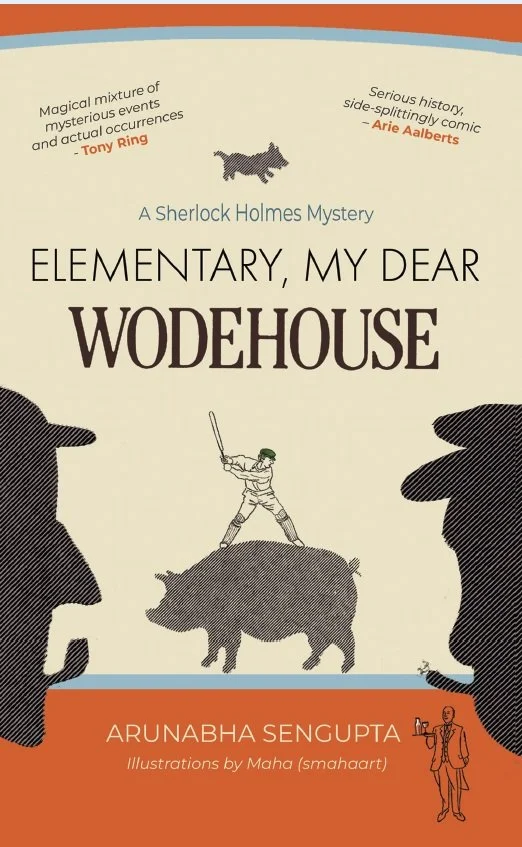
‘Arun has created a magical mixture of mysterious events and actual occurrences. As Arun’s footnotes show, there is documented evidence for much of what he writes. His particular strength is to combine the reported incidents and exchanges which he has traced in his extensive research … with his inbuilt instinct for storytelling, surprise, imagination and humour.’
The book is also illustrated, and that too has a story behind it.
‘Cricket readership is a demanding one. The last time I presented a copy of Sherlock Holmes and the Birth of the Ashes to one of the leading lights of cricket’s several societies and associations, I watched him thumb through the pages and enquire in a flummoxed tone, “There are no photographs in this?”’
Photographs being a rum notion in a novel, Sengupta turned instead to the artist Maha, who has drawn the book’s illustrations and designed what he calls ‘a corking cover’.
Others checked the details. Vikas Sonak of the Dutch P.G. Wodehouse Society vetted the Wodehouse tone and voice, and went through the manuscript with a fine toothcomb besides. Frantiska Berankova edited it, taking the alien cricketing terms in her stride. Abhishek Mukherjee, Sreeram Iyer and Mayukh Ghosh each read it with their cricket historian eyes, closing the remaining gaps between factual bat and pad.
The book is published by Frames Publishing, Netherlands, whose team helped with the professional editing and design guidance. Sengupta’s daughter Meha went over the cover and illustrations. ‘They have also been a pleasure to work with,’ Sengupta says, lauding their final production and editing.
Asked about the differences between this and Sherlock Holmes and the Birth of The Ashes - aside from the illustrations - Sengupta says, ‘A lot have happened in the interim years - 2015 till now. I have published a lot of non-fiction books on cricket and they all have all dealt with certain core elements. This is pure entertainment and fun, but the history as well as the relevant elements do find their designated places.’
The dedication goes to Alpha and Omega, the author’s two cats. Between them, he says, they played the role of Leonora, Wodehouse’s stepdaughter, to whom he dedicated Heart of a Goof, ‘without whose never-failing sympathy and encouragement this book would have been finished in half the time.’ Their claw marks on his study door record every evening his writing ran past their dinner hour.
‘In a book such as this, it is always the case of finding something you could have included,’ the author adds. ‘Some historical events and occurrences come to light which could have been seamlessly merged with the story. But overall there is plenty of twists and turns, and mixture of fact and fiction. I am quite satisfied with it.’
The early readers agree that it is more than a romp. Arie Aalberts (author of Modern Dutch) has called it ‘serious history, side-splittingly comic’, and warned that ‘it will be a tragedy if it is categorised as just comic fiction’.
Elementary, My Dear Wodehouse is available from October 2026 from Frames Publishing and all the usual outlets, in paperback and on Kindle.
If you've read Wodehouse, this will make you reread. If you haven't, you will now!
Elementary, My Dear Wodehouse
Arunabha Sengupta, with illustrations by Maha
Frames Publishing· ISBN 978-94-92203-17-5
Paperback: £9.99
Kindle: £6.99