
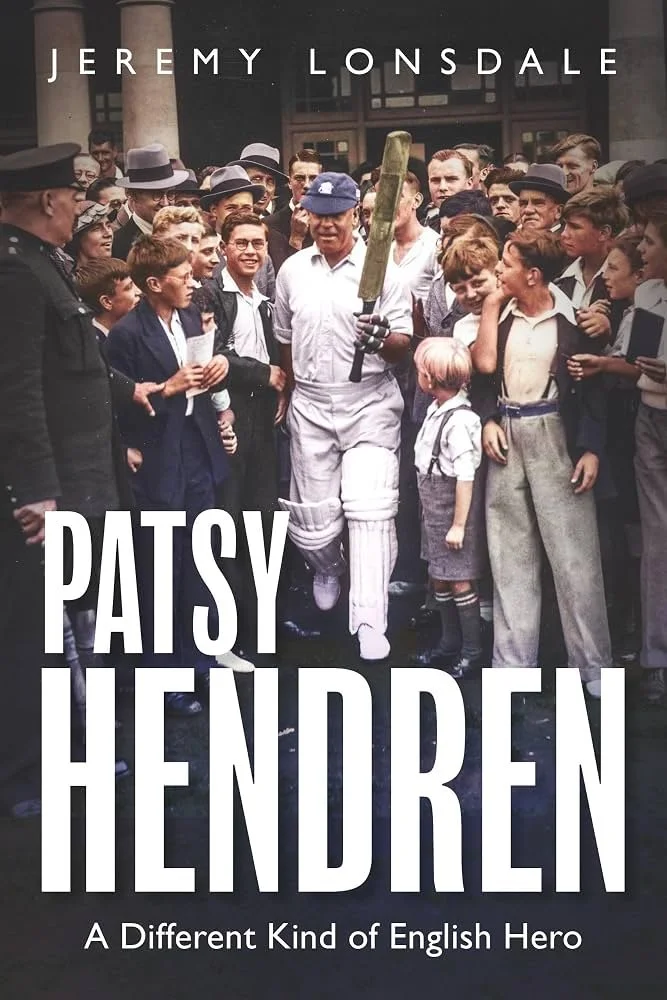
Jeremy Lonsdale talks to Mayukh Ghosh about his new book on Patsy Hendren, the first since 1969 about one of the great runscorers of all time, and the first to cover his football as well as his cricket career, and so much more.
What made you to decide to write about Hendren?
Well, after writing about Bill Bowes I wanted to research someone from a similar period. Partly because cricket was just so popular in England in the 1920s and 1930s, but also because it was well covered in the press in an increasingly modern, personality-driven way. I also wanted someone who did more than just play cricket, who had other aspects to their life, as it just makes the research more interesting. And Hendren had that in spades – his football, his fundraising for good causes, his Catholicism, his articles and books, his coaching and indoor school, his contacts in the London theatre and music worlds, even the fact that he coached at a Butlin’s holiday camp one year. He was more than a cricketer, he was a popular personality of the inter-war years.
I was also tempted to write about Hendren when I discovered that the only book about him was 57 years old and specifically didn’t cover his football career. Ian Peebles indicated in his Introduction he wouldn’t be covering it and yet I don’t think you can write about someone who played professional football regularly until their late 30s alongside a demanding cricket career and ignore it. In my opinion, playing football, even in the lower divisions, alongside cricket magnifies Hendren’s achievements as a cricketer (and a footballer), and the demands of one sport impacted on the other, especially as the seasons overlapped in April and September.
The amount of energy expended was just incredible – 833 first-class cricket matches, over 400 professional football games. He never really stopped for three decades. I married up a schedule of his Brentford matches with the data on CricketArchive on his first-class cricket and between 1911 and 1927, ignoring wartime, he had just four months when he did not play several matches of one or other sport or both, and that was because he was at sea to or from Australia. I like the story of when he played both sports on one day in 1919. He started in a charity cricket match in Twickenham in the morning, was driven to play for Brentford in a league match against Portsmouth after lunch, and then went back and scored fifty in the cricket. And sang in a concert after the match!
Was he the larger-than-life personality he is usually depicted?
Yes and No. Clearly Hendren was a very popular player who loved entertaining, was a humorous man, and was worshipped for his on- and off-field antics. He enjoyed engaging with crowds and had a whole repertoire of tricks. The press loved this, and I am sure magnified this side of his personality. Arthur Mailey turned him into a cartoon character in 1928 and there are numerous amusing stories involving him – some probably true, some likely to be embellished in the retelling.
But as I say in the book, there was a lot more to Hendren than that. He was a far more serious individual than usually depicted. My book includes a chapter ‘Fun, Faith and Philanthropy’ because I wanted to address this point head on – yes, he was an entertainer, but this was only part of his character. He was a devout and active Catholic, and gave a lot of time to fundraising for church building and hospital causes. He was also very serious about his cricket and thought a lot about the game and how it should be played; he appreciated that it had helped him escape a difficult background.
Hendren was also a surprisingly private person. I thought it was very interesting that Ian Peebles wrote in his book that when (in the late 1960s) he spoke to some of Hendren’s surviving friends, they didn’t know much about him. And Peebles himself admitted he had been unaware Hendren was a Catholic, despite this being very important to him and even though they played together.
Why did you call him ‘A Different Kind of English Hero’?
Hendren didn’t fit the mould of a typical English sporting hero of the time as a sort of exemplar of masculinity. As I say in the book, he wasn’t a stylist like Hobbs and Woolley, he had none of the glamour of Chapman, and he didn’t have the polish or poise of Sutcliffe. He didn’t have the confident stride or physique of the inter-war batting hero; he was short and some said he ‘waddled’ to the wicket. He also spoke his mind which was quite unusual for professional cricketers of the time. Yet he was a hero to so many, in part because of all these things. He was loved at Lord’s and around the country, but also abroad in Australia and the West Indies. And despite all this, he has been forgotten to a surprising extent. As David Frith suggested to me, he is surprisingly ‘under-sung’.
Where do you think he stands among the ‘greats’?
I came away from writing the book thinking he was a slightly lesser cricketer than I had assumed, but a greater person. By that I mean, he was obviously a remarkable run-maker. His achievements will remain – the third highest runscorer of all time, the highest number of runs for Middlesex, at Lord’s and in a West Indian season, the second highest number of centuries ever, the ninth highest number of catches, the fifth highest number of first-class appearances. These are remarkable figures and the majority of his runscoring was after 30, his pre-war record having been pretty modest. At the same time, his average against Australia is lower than against other Test sides just as his average against Yorkshire, the strongest county at the time, is lower than against other counties. He failed quite a bit at Test level and was never really sure of his England place even though he made 51 appearances.
But alongside all this, he was clearly a very generous man with all his work for religious and hospital causes, and he was loyal to his clubs and to his local communities. So, I felt he was a lot more than just a good sportsman and comedian as he has sometimes been portrayed. There was much more substance to him, and he was admired by a wide range of people inside and outside cricket because of this. I liked the story of Hugh Walpole, one of the great literary figures of the 1920s, standing beside him on two occasions in a hotel bar for half an hour and being too frightened to speak to him.
Given that you had so much to cover about the man and not only the cricket, were you at all wary about the length of the book and was there a chance of overdoing one section and underdoing others?
Yes, writing at too great a length is always a risk although the publisher set a word limit which acts as a good discipline. I tried to focus on the most important games in both elements of his sporting life because otherwise it gets boring for me and, more importantly, the reader, and you also lose the thread of the overall story among all the centuries and goals. I also tried to be careful about not quoting his many newspaper articles too much. Many gave his views on what was happening in contemporary cricket, which is interesting in itself, but I found the articles were most useful where they gave an insight into his form or personal concerns.
For me, the biggest risk of overdoing or underdoing anything related to getting the balance right between cricket and football. Ultimately, his career in the former was far more distinguished than the latter, but I wanted to cover football in sufficient detail to explain how he juggled the two sports for so long. I assumed that I was writing a cricket book which included coverage of football, so it was never going to be 50:50. I was careful about how much attention I gave to the hundreds of football matches he played.
What regrets do you have about the book?
Even more so than with my book on Bill Bowes, I feel that it would have better to have written about Hendren when more people were around who had known him personally or watched him bat. I did speak to Peter Parfitt, who played for Middlesex in the 1950s when Hendren was county scorer, and he recalled a generous and approachable man, but there would inevitably be some distance between a young player and the old coach. And to remember seeing Hendren bat would mean you had to be about 100 now. That being said, it is obviously easier to access a wealth of material about Hendren now than it was when Ian Peebles wrote his book. And I think that helped me get a rounded idea of the man.
Patsy Hendren: A Different Kind of English Hero by Jeremy Lonsdale was published by Pitch Publishing in June 2026.