
by Mayukh Ghosh
“This would present the County game in a fresh way, which may well recall the deserters, attract new and regular spectators from an entire fresh section of the population; and perhaps even achieve the financial solvency so lately tacitly regarded as impossible”
This was John Arlott’s reaction when the Sunday League was announced and John Player came forward to play the sponsor’s role.
The Cavaliers, about seven years ago, began the revolution, in a year the amateurs and professionals were no longer treated differently.
And at Leicestershire, their secretary Mike Turner was devising a tournament of one day matches.
He called it the ‘Midlands Knockout Competition’. 65 overs a side.
Leicestershire, Derbyshire, Nottinghamshire and Northamptonshire participated.
The very next year the Gillette Cup began.
It was all changing rather fast. At a time when the traditional county matches were no longer drawing the crowd.
The John Player League began in 1969 and went on till 1986. John Player left the scene after that.
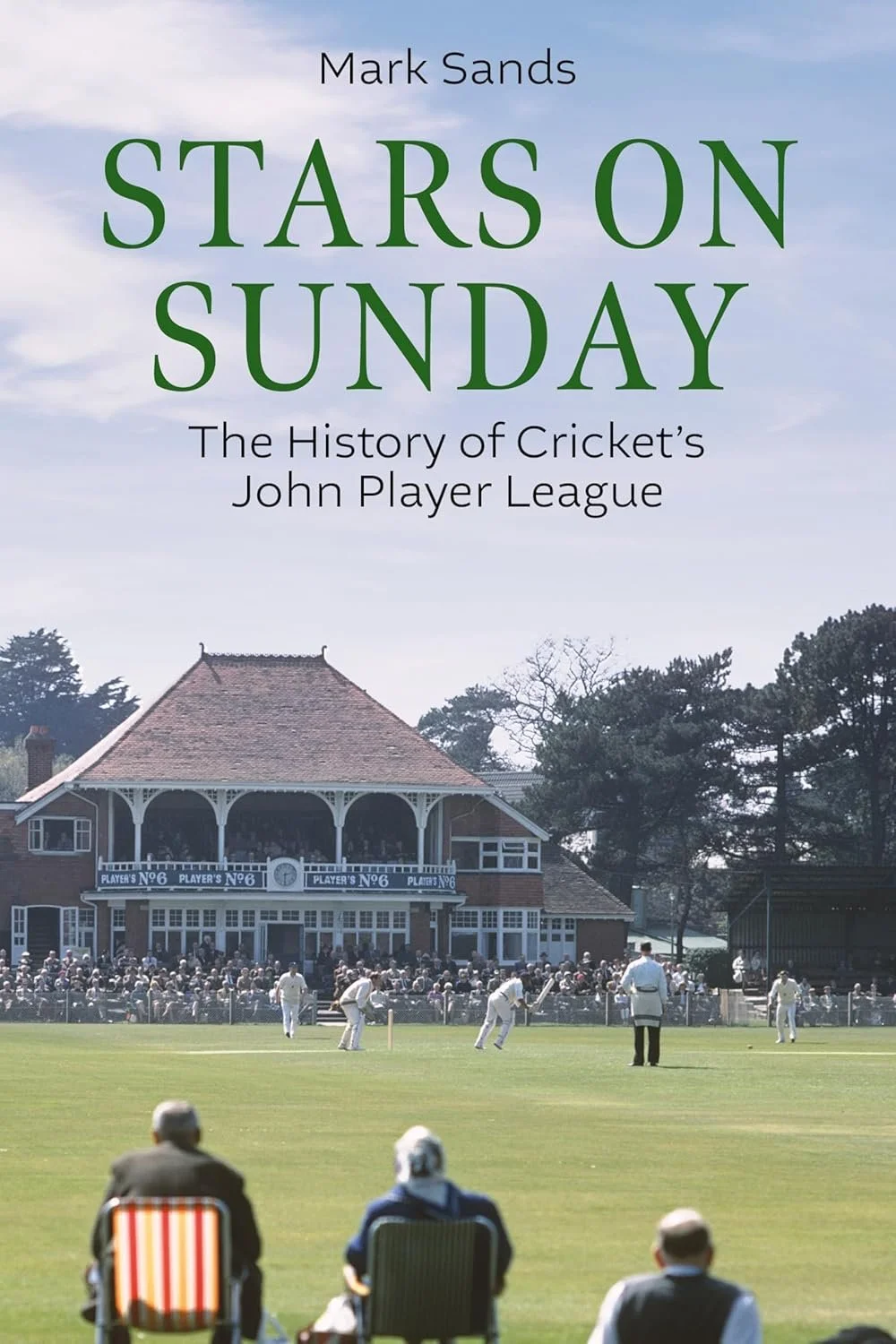
Now, 40 years later, there is a history of the tournament by Mark Sands who always had a soft spot for the tournament.
He coaches the juniors at his local club and is a member of Lancashire CCC.
It all began for him when he went to watch cricket on Sunday.
“My earliest memories of watching county cricket are John Player Sunday League games, with my dad. The Lancashire side of the 1970s included Clive Lloyd, Farokh Engineer and Colin Croft, and it felt special watching these stars of world cricket.
Clive Lloyd became an instant favourite, I had never seen anyone hit a cricket ball so hard or so far, but it also struck me that county cricket seemed a broad church, older experienced players mixing with youngsters making their way in the game, and not everyone looking like a prime athlete - Jack Simmons also becoming a player I was eager to see play.
Into the 1980s (when I started to play the game as a junior at club level) Graeme Fowler was the one to watch at the top of the Lancashire order. I recall the 1986 season where he made 2 centuries in the JPL, forming a great opening partnership with Gehan Mendis who had joined Lancs from Sussex.
From watching the JPL it was a natural development to attend County Championship matches during the school holidays, and Test cricket, too, although my first experience of a Test at Old Trafford was a complete washout against West Indies in 1980 - no refunds in those days, just a day sat in the drizzle, watching the umpires wander out periodically. I didn't see a ball bowled but managed to grab the autograph of Brian Rose.”
The affection Sands has for the tournament was a prime reason behind him embarking on this project. But there was more to it.
“In recent years, as the domestic schedule became messier, with the various competitions adversely impacting each other, it felt like supporters were looking back to the days of regular Sunday scheduling with a sense of longing, and whilst the scorecards and stats of the JPL were available, nobody had really attempted to tell the story of the league, from its inception through the regular excitement that the matches generated.
So, with the intention of one day trying to tell the tale, I was watching a county championship game at Blackpool and eavesdropped on a conversation from a group of supporters who were reminiscing about the JPL, and this proved the trigger, making my mind up that I should get on and write the book!”
Writing about favourite things can often lead to losing objectivity, thus resulting in a biased version full off nostalgia and only nostalgia. Sands was wary of this.
“I wanted to tell the history of the JPL, not my story or my experiences (as they did not cover the full period, and were too narrow in scope, with predominantly Lancs and also Yorks fixtures).
It was important to consider the factors that led to the formation of the league (the pioneering role played by the International Cavaliers, for example), the lack of other sporting and leisure options on Sundays in the late 60s/early 70s, the role played by television in spreading the popularity of the league, and the sponsorship support, which worked well for both parties as it gave exposure for the tobacco company in the face of a ban on regular tv advertising, and prize money for the cricketers to compensate for them losing their 'rest day')
“I then felt that a chronological approach would work best to tell the story. Of course, some seasons were more exciting than others (1976 being the classic) but the season-by-season approach allows the reader to understand the early dominance of fist Lancashire, then Kent, how Somerset came so close before finally tasting success in 1979, the dominance of Essex in the 1980s, but also the surprise winners, such as Warwickshire in 1980 (after finishing last the season prior) and Yorkshire in 1983 (winning the JPL but finishing bottom of the championship)
“With 18 seasons to cover, it was impossible to try and cover all of the key matches, so I tried to ensure the 'flavour' of the season came across, key performances with bat and ball, but also the views of players, supporters, commentators where relevant. Hearing some of the stories from supporters attending matches which have stayed fresh in their minds, even after all these years, was particularly satisfying.”
The sources and the verifying of fact is always important for a project like this. Sands found his sources in cricketers, journalists, photographers, spectators,….
“I spoke to a couple of cricketers, in addition to using relevant quotes from the research materials. The principal chat was with Dilip Doshi, who conveyed his enjoyment of playing in the Sunday League.
He was a key part of the Warwickshire side who won the league in 1980 - helping transform them from bottom of the table in the previous season, and he emphasised the wonderful team spirit that captain Bob Willis and team manager David Brown managed to galvanise.
“I also wanted some memories from supporters, and several were helpful in this regard: author Colin Babb, commentator Dan Whiting, David Griffin at Derbyshire, Lawrence Hourahane at Glamorgan and Dave Allen at Hampshire, for example, who recalled Sunday League fixtures that remained fresh in the memory all these years later.
“I was surprised at the lack of live action footage that remains. There are some clips of matches on YouTube (I have added some of these to my website www.starsonsundaybook.com) but most of the research centred around scorecards, match reports, and reflections on the Sunday League from various player autobiographies and diaries, the JPL matchday programmes, books on memorable one-day fixtures and the history of cricket broadcasting were vital aids, in addition to my memories of the league (from '78 onwards).”
The pleasure of writing a book like this often lies in the process of getting the job done. The joy of discovering something unexpected remains unmatched….
“A few surprising facts were discovered along the way and it’s always a joy to find them.
I think my favourite, maybe because I currently play club cricket alongside my son, was a father and son fact relating to the d'Oliveiras. When Damian scored a century in 1985 against Surrey, he joined his father as a JPL centurion, Basil having scored 100 against the same opposition 12 seasons earlier. Both innings contained a six off the bowling of Surrey spinner Pat Pocock!
“My favourite anecdote came from a lovely chat I had with former Indian Test spinner, Dilip Doshi, who sadly passed away a few months ago. Having returned the second most economical figures in the competition's history, 8-7-1-1 for Nottinghamshire at Northampton in 1977 (opening the bowling), he was dropped from the side for the following Sunday fixture in favour of Peter Hacker, as it was felt the wicket would favour seam over spin. That plan didn't quite work out, as Hacker failed to take a wicket in his 8 overs and Kent comfortably defeated Notts by 38 runs.”
It is very common to discover something crucial or finding a different dimension to the story once the manuscript is sent to the printers. Sands, though, didn’t have anything to rue about.
“I think the chronological structure, although the obvious approach, was the best one to take when telling the story of the league and how it developed.
It allows the reader to understand how first Lancashire, then Kent, Hampshire and latterly Essex became the dominant teams, but I also felt it was important to start pre 1969, to show how and why the JPL came into existence, the importance of the Cavaliers, for instance, and a chronological approach was the best way to achieve this.
“I considered a statistical section/appendix but decided the records exist in other publications and left the book ‘telling the story’ rather than recording the stats.”
The book is available from publisher ‘Pitch Publishing’ and from the author’s website: https://www.starsonsundaybook.com/author-copies.